Japanese Family Names And Their Meanings
When I first started studying Japanese family names, I was surprised by how often I saw the same ones appear in dramas and anime. Over time, I learned that Japan has a small pool of surnames compared to many Western countries, which is why names like Watanabe, Tanaka, Yamaguchi, and Suzuki feel so familiar.
As I looked deeper into lists on places like Family Education, I began to appreciate how each Japanese last name carries its own meaning, origin, and cultural heritage. Even simple details like noticing how 1 in 10 people share ultra-common surnames such as Satō, Takahashi, or Kobayashi made me understand why so many characters across Japanese dramas share similar names.
For learners, writers, and J-drama enthusiasts, exploring these names from A to Z becomes a fun way to see how an anime family or a real one might be connected through patterns of nature, geography, or history.
What I love most is how these surnames reveal tiny stories within their kanji. Names like Itō, Katō, and Nakamura hold simple meanings such as wisteria, add, or middle, while others like Yamamoto and Kobayashi point to landscapes like mountain, forest, or rice field.
Even playful facts, like the prediction that 2531 might see everyone named Satō, show how deeply rooted these names are in daily life. When I help friends choose names for projects, I often remind them that understanding these ultra-common surnames, these top ten picks, and the cultural weight behind them can make any fictional family feel instantly real.
Whether you’re a writer, a new learner, or someone exploring Japanese identity, there’s something meaningful in every surname, from simple images like bell, tree, bridge, or cross to roles like assistant or places like an area or base.
Even resources created by people like L. Elizabeth Forry make it easier to explore 100 well-known names and choose the one that fits your story best.
Understanding The Structure Of Japanese Family Names
Japanese family names, also known as Japanese surnames, carry meanings tied closely to nature, geography, occupations, and ancient cultural traditions. Many Japanese names reflect everyday surroundings mountains, rivers, forests showing how families were once connected to specific places or roles.
As I studied these names more deeply, I began noticing how certain meanings repeat, like references to trees, fields, or water, forming patterns that help you guess a surname’s origin even before you look it up.
- This makes exploring Japanese family names especially exciting for learners, writers, and worldbuilders.
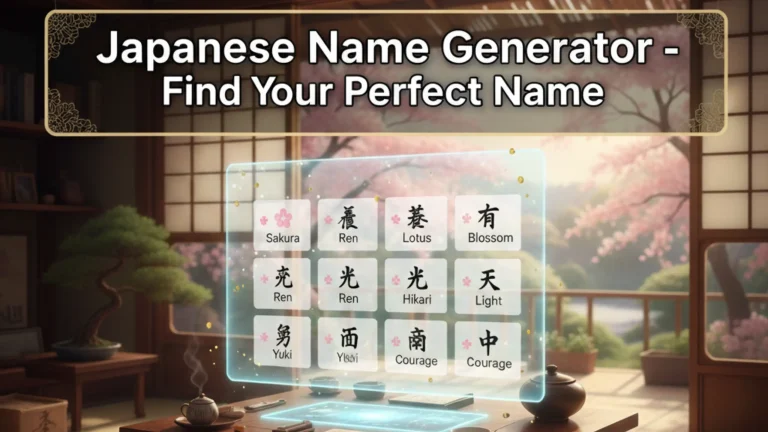
- Because many readers also search for Japanese boy names, Japanese girl names, and full-name combinations, understanding how family names work makes it easier to use a Japanese name generator or pick names manually.
- And if you’re working on character creation or story building, this knowledge becomes a natural bridge to other topics such as choosing the right first name or matching the tone of your setting with authentically styled Japanese surnames.
Why Japanese Surnames Are So Meaningful
Many Japanese family names date back centuries, shaped by countryside landscapes and historical communities. That’s why so many surnames include kanji for elements such as “mountain,” “rice field,” or “forest.”
For example, names like Yamamoto, Tanaka, and Kobayashi reflect places where families once lived. Others, like Sato or Ito, trace their origins to noble clans or iconic symbols.
Popular Japanese Family Names
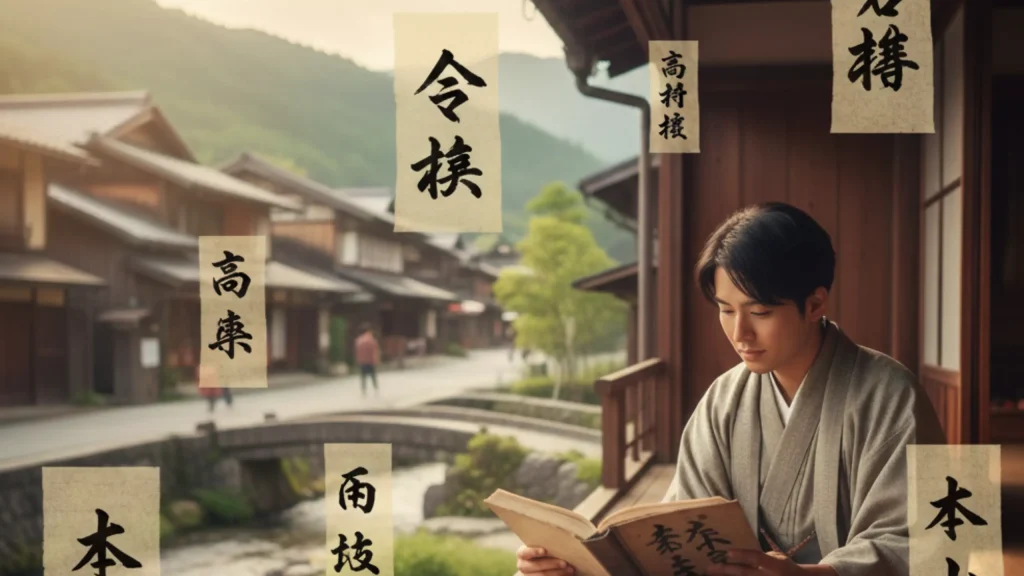
Here’s a helpful collection of common Japanese surnames along with simple meanings. These work beautifully for stories, character design, or understanding naming traditions.
| Surname | Meaning |
|---|---|
| Sato | wisteria |
| Suzuki | bell tree |
| Takahashi | tall bridge |
| Tanaka | middle field |
| Watanabe | cross-border |
| Ito | wisteria |
| Yamamoto | mountain base |
| Nakamura | middle village |
| Kobayashi | small forest |
| Kato | add wisteria |
| Yoshida | lucky rice field |
| Yamada | mountain rice field |
| Sasaki | assistant |
| Yamaguchi | mountain mouth |
| Matsumoto | pine origin |
| Inoue | above the well |
| Kimura | tree village |
| Shimizu | pure water |
| Hayashi | woods |
| Abe | peace |
| Kondo | near the hall |
| Ishikawa | stone river |
| Nakajima | middle island |
| Ueda | upper field |
| Harada | meadow |
| Sakamoto | hill base |
| Okada | ridge field |
| Fujita | wisteria rice field |
| Kaneko | golden child |
| Takeuchi | bamboo within |
| Ishii | stone well |
| Ando | calm wisteria |
| Fukuda | fertile field |
| Kuroda | black field |
| Matsuda | pine field |
| Hasegawa | long valley |
These surnames pair perfectly with first names from Japanese boy names and Japanese girl names lists, and using a Japanese name generator can help you experiment with combinations quickly.
Japanese Boy Names For Pairing With Surnames
Choosing the right Japanese boy names to pair with classic Japanese surnames can completely shape the personality, background, and emotional tone of a character. Japanese names often carry powerful meanings inspired by nature, virtues, seasons, or traditional craftsmanship.
When combined with well-known surnames like Sato, Takahashi, Mori, or Yamamoto, the full name gains a sense of history and cultural grounding that feels natural and authentic.
| Name | Meaning |
|---|---|
| Haruto | sunlight |
| Ren | lotus |
| Daiki | brightness |
| Satoru | wisdom |
| Kaito | ocean |
| Riku | land |
| Takumi | artisan |
| Hiroshi | generous |
| Yuuto | gentle |
| Naoki | honest |
| Hayato | falcon |
| Ryota | refreshed |
| Itsuki | timber |
| Minato | harbor |
| Sho | soar |
| Kazuki | harmony |
| Akira | clarity |
| Haruki | shining |
| Takeru | warrior |
| Masato | justice |
| Shinji | true |
| Kouhei | peace |
| Eito | eternity |
| Taiga | river |
| Isamu | courage |
| Makoto | truth |
| Ryusei | comet |
| Shun | swift |
| Yuta | abundant |
| Arata | fresh |
| Keita | blessed |
| Ryoma | dragon |
| Subaru | unite |
Japanese Girl Names For Full-Name Creation
Choosing Japanese girl names to pair with traditional surnames can bring a sense of elegance, softness, or emotional depth to any character or real-life naming choice.
Japanese names often draw inspiration from nature, seasons, colors, emotions, and poetic imagery, making them especially beautiful when used in stories, games, novels, or creative worldbuilding.
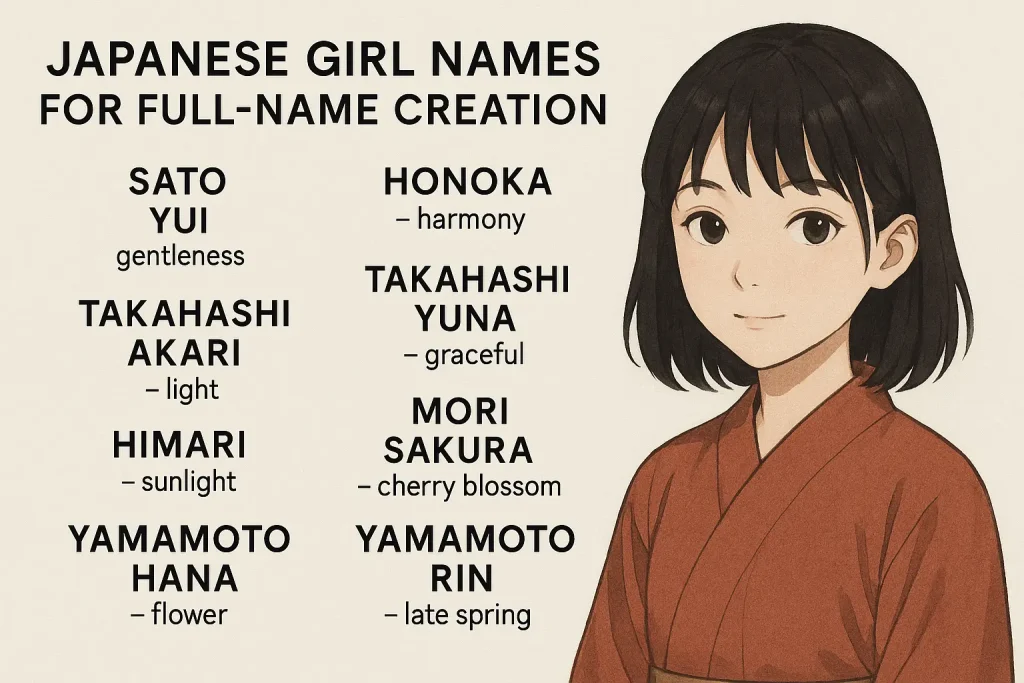
When I work on character design, I always find myself returning to these names because each one feels like its own tiny story, shaped not just by sound but by the meaning carried through its kanji.
- Some names have a bright and blooming quality, like Sakura — cherry blossom, a name tied to beauty and the fleeting nature of spring in Japan.
- Others, like Yui — tie, bind, carry a gentle sense of connection or unity, perfect for characters known for compassion or emotional strength. Aiko — love child is warm and affectionate, while Haruka — distant spring adds an air of elegance and dreamy innocence.
- If you want a name that holds depth, Chihiro — thousand fathoms brings a sense of mystery and inner richness. Softer names like Mei — sprout and Yuna — gentle offer calm, peaceful energy, while Nozomi — hope gives a feeling of optimism and resilience. Hikari — light brings brightness and clarity, and Ayaka — colorful flower feels artistic, radiant, and full of life.
- These names fit beautifully with many Japanese family names—from classic surnames like Sato or Nakamura to softer ones like Mori or Aoki. When paired thoughtfully, a full name can express personality, background, mood, or even the role a character plays in a story.
- Whether you’re writing a school setting, crafting a fantasy world, or simply learning more about Japanese names, this collection of girl names serves as a gentle guide to building expressive and memorable full-name combinations.
| Name | Meaning |
|---|---|
| Sakura | blossom |
| Yui | bind |
| Aiko | love |
| Haruka | spring |
| Chihiro | thousand |
| Mei | sprout |
| Nozomi | hope |
| Hikari | light |
| Yuna | gentle |
| Ayaka | flower |
| Hana | flower |
| Riko | jasmine |
| Miyu | kindness |
| Sora | sky |
| Ako | brightness |
| Kanna | guidance |
| Rina | village |
| Nanami | seven |
| Mio | beautiful |
| Hinata | sunlight |
| Miku | future |
| Naomi | honesty |
| Airi | affection |
| Asuka | fragrance |
| Eri | blessing |
| Ayumi | walk |
| Kiyomi | purity |
| Kokoro | heart |
| Yuriko | lily |
| Sumire | violet |
| Tomoe | wisdom |
| Reina | clean |
| Mirai | future |
| Keiko | respectful |
| Suzume | sparrow |
| Akari | brightness |
| Yume | dream |
| Koharu | small sun |
| Sayuri | lily |
| Rena | graceful |
| Wakana | harmony |
| Misaki | bloom |
| Fuyuko | winter |
| Ami | friend |
| Hina | sun |
| Aina | love |
| Shiori | poem |
| Mai | dance |
| Yurina | reason |
| Kanon | sound |
| Risa | growing |
Comprehensive Japanese Surnames For Authentic Name Building
apanese surnames carry deep cultural history and often reflect landscapes, occupations, natural elements, or ancestral identity.
They are central to building believable Japanese characters whether you’re writing a novel, creating a manga cast, planning a fantasy world, or designing NPCs for games.
Because family names traditionally come before given names in Japan, choosing the right surname is just as important as picking the first name.
| Surname | Meaning |
|---|---|
| Sato | wisteria |
| Suzuki | bell |
| Takahashi | bridge |
| Tanaka | field |
| Watanabe | cross |
| Ito | wisteria |
| Yamamoto | mountain |
| Nakamura | village |
| Kobayashi | forest |
| Kato | wisteria |
| Yamada | ricefield |
| Sasaki | assistant |
| Yamaguchi | gateway |
| Matsumoto | pine |
| Inoue | well |
| Kimura | tree |
| Shimizu | water |
| Hayashi | woods |
| Abe | peace |
| Kondo | hall |
| Ishikawa | stone |
| Nakajima | island |
| Ueda | upperfield |
| Harada | meadow |
| Sakamoto | slope |
| Okada | ridge |
| Fujita | wisteria |
| Kaneko | metal |
| Takeuchi | bamboo |
| Arai | new |
| Fujimura | wisteria |
| Noguchi | fieldmouth |
| Miura | bays |
| Murakami | uppervillage |
| Honda | origin |
| Otsuka | mound |
| Kataoka | hill |
| Sugiyama | cedar |
| Chiba | thousand |
| Araki | wildtree |
| Fujimoto | wisteria |
| Hasegawa | valley |
| Oshima | bigisland |
| Kojima | smallisland |
| Tamura | ricevillage |
| Ishii | stonewell |
| Ando | calm |
| Fukuda | fortunate |
| Kuroda | blackfield |
| Matsuda | pinefield |
| Shirai | white |
| Okamoto | ridgebase |
| Kinoshita | beneath |
| Hirano | plain |
| Sugimoto | cedarbase |
| Imada | nowfield |
| Hamada | shore |
| Aoyama | bluemountain |
| Nishimura | westvillage |
| Nakano | middleground |
| Kurokawa | blackriver |
| Matsushima | pineisland |
| Ueno | upperwild |
| Sugawara | reedplain |
| Yamashita | mountainbelow |
| Nakata | middlefield |
| Morita | forestfield |
| Komatsu | smallpine |
| Omura | bigvillage |
| Minami | south |
| Kitamura | northvillage |
| Ishida | stonericefield |
| Oki | opensea |
| Nishida | westfield |
| Hashimoto | bridgebase |
| Mori | forest |
| Kubo | hollow |
| Hirose | wideswamp |
| Nozaki | fieldblossom |
| Aikawa | lovestream |
| Yamazaki | mountaincape |
| Takagi | talltree |
| Iwata | rockfield |
| Kumagai | beartop |
| Sena | rapids |
| Mochizuki | fullmoon |
| Kurosawa | darkswamp |
| Inoue | welltop |
| Tatara | furnace |
| Mashima | trueisland |
| Kunii | kingdomwell |
| Tsukada | moundfield |
| Hirata | flatfield |
| Tokuda | virtuefield |
| Mizutani | watervalley |
| Oda | smallfield |
| Anzai | quietwest |
| Hori | trench |
| Torii | birdhouse |
| Sawada | swampfield |
| Nishio | westplain |
| Yui | tie |
| Hamaguchi | shoremouth |
| Kawamura | rivervillage |
| Nakahara | centralplain |
| Ishibashi | stonebridge |
| Taniguchi | valleymouth |
| Utsumi | inlet |
| Takano | tallfield |
| Ohara | bigplain |
| Kano | deityfield |
| Furuya | oldhouse |
| Muta | dreamfield |
| Tani | valley |
| Yasuda | peacefulfield |
| Saeki | peninsula |
| Kanbara | winterplain |
| Oikawa | chasingriver |
| Kamei | turtlewell |
| Yahagi | eighttrees |
| Tominaga | wealthlong |
| Nagano | longfield |
| Igarashi | fiftystorm |
| Higuchi | entrance |
| Komaki | smallcastle |
| Kawai | riverbend |
| Naito | innerwisteria |
| Matsuura | pineriver |
| Esaki | inletcape |
| Kirishima | mistisland |
| Ogasawara | smallmeadow |
| Mizuno | waterfield |
| Shindo | newway |
| Umehara | plumplain |
| Tokunaga | virtueforever |
| Shinoda | bambooplain |
| Yoshinaga | goodforever |
| Ono | smallfield |
| Tsuruta | cranefield |
| Sekine | barrierroot |
| Kawabata | riverflag |
| Yagami | eightgods |
| Sonoda | gardenfield |
| Tateishi | standingstone |
| Kuwayama | mulberrymountain |
| Nishiyama | westmountain |
| Shinohara | bambooplain |
| Kitagawa | northriver |
Conclusion
Japanese family names offer a window into geography, history, and cultural identity. Whether you’re studying the language, forming characters for creative projects, or searching for meaningful names, understanding the role of Japanese surnames gives you a stronger foundation.
Combined with beautiful Japanese boy names, expressive Japanese girl names, and useful tools like a Japanese name generator, you can create authentic and memorable name combinations that fit any purpose from storytelling to personal exploration.