Japanese Surnames – History, Meaning & Cultural Legacy
When I first began researching Japanese surnames, I was fascinated by how deeply they connect to family, clan, and societal identity. Long before the modern era, around 250 AD, powerful clans and small kingdoms in Japan began shaping the structure of names through the Uji-Kabane system, where a ruler assigned a designation or rank to each group.
These early kabane and titles, such as Omi, Muraji, and Tomonomiyatsuko, reflected not just status, but trusted occupations, long-standing loyalty to the Yamato line, and service to the early emperor and government officials.
From my own studies, what stood out most was how these inherited systems influenced the entire world of naming, even as communities evolved across countries and centuries.
The written forms, whether in kanji, hiragana, or through later Romanizing, added even more layers of meanings shaped by characters, history, and cultural shifts.
Growing up admiring Japanese culture, I always noticed how people who moved to western regions or global communities sometimes adjusted the order of their names, placing the surname last while preserving its cultural weight.
Even today, tracing a surname back to its ancient origins can reveal stories of clans, early political structures, and the beginnings of structured naming in Japan.
Whether tied to geography, rank, or family duty, each surname feels like a thread connecting the past with the present, showcasing how a tradition born in the Uji-Kabane era continues to influence identity across the modern world.
Understanding Japanese Surnames And Meanings
The surnames carry layers of history, culture, and ancestral identity. Many of them were shaped centuries ago, rooted in the landscapes where families lived, the roles they fulfilled in their villages, or the spiritual beliefs they cherished.
Because Japan is a country surrounded by mountains, rivers, forests, and coastlines, it’s no surprise that so many surnames reflect nature and the environment.
Others highlight virtues, responsibilities, or symbolic imagery passed down through generations, giving each surname a unique story.
Nature & Meaning-Based Surnames
| Surname | Meaning |
|---|---|
| Yamamoto | Base of the mountain |
| Tanaka | Rice field |
| Inoue | Above the well |
| Kawashima | River island |
| Morita | Forest field |
| Nakamura | Middle village |
| Kobayashi | Small forest |
| Fujimoto | Wisteria origin |
| Ishikawa | Stone river |
| Hasegawa | Long valley river |
| Okamoto | Hill base |
| Ueda | Upper rice paddy |
| Hayashi | Forest |
| Kawaguchi | River mouth |
| Yamaguchi | Mountain entrance |
| Sakurai | Cherry blossom well |
| Aoyama | Blue/green mountain |
| Mizuno | Of water |
| Shimizu | Clear water |
| Takagi | Tall tree |
| Oikawa | Chasing river |
| Kondo | Near the shrine |
| Noguchi | Field entrance |
| Fujita | Wisteria field |
| Komatsu | Small pine tree |
| Yamashita | Beneath the mountain |
| Moriyama | Forest mountain |
| Sugiyama | Cedar mountain |
| Hamamoto | Seaside origin |
These expanded surname examples show how deeply everyday life fields, trees, rivers, seasons, and even subtle places shaped the earliest family identities in Japan.
From towering mountains to quiet wells, each name acts like a small snapshot of where a family once lived or what they cared for.
Common Japanese Surnames
Common surnames form the foundation of Japan’s naming culture and are some of the most familiar family names both inside the country and around the world. These surnames often come from nature, geography, or the occupations and roles families held in ancient communities.
Because of their simplicity, soft pronunciation, and deep historical roots, these names are frequently used for real families, fictional characters, and even modern baby name inspiration.
- What makes these surnames especially meaningful is how they connect everyday life with traditional Japanese values.
- Many of them describe landscapes, forests, bridges, rice fields, or symbolic elements like wisteria and bells imagery that also appears in japanese boy names, reflecting how deeply nature and heritage influence naming in early Japanese society.
- Whether you’re exploring Japanese male names and surnames or Japanese female names and surnames, these popular surnames blend beautifully with almost any first name, making them versatile, timeless, and culturally rich.
- Below is an expanded list of widely recognized surnames that continue to be passed down through generations:
| Surname | Meaning |
|---|---|
| Sato | Wisteria; help |
| Suzuki | Bell tree |
| Takahashi | High bridge |
| Kobayashi | Small forest |
| Watanabe | Crossing |
| Nakamura | Middle village |
| Yamamoto | Base of the mountain |
| Kato | Increase; wisteria |
| Ito | Thread; wisteria |
| Tanaka | Rice field |
| Sasaki | Helpful bloom |
| Yamaguchi | Mountain entrance |
| Matsumoto | Pine tree origin |
| Inoue | Above the well |
| Harada | Field |
These surnames are universally recognized and easy to pronounce, making them excellent choices for stories, character creation, naming projects, or exploring cultural heritage.
Whether you want something traditional, simple, or deeply rooted in history, common surnames offer a strong foundation for meaningful name combinations.
Uncommon & Rare Japanese Surnames
If you’re searching for names that feel more distinctive and carry a sense of mystery, uncommon surnames and rare surnames open the door to a more poetic and historical side of Japanese culture.
These surnames often trace back to older, smaller regions of Japan, places that once existed as quiet mountain villages, sacred forest communities, or isolated coastal areas.
Because many of these families lived in areas tied to specific occupations, rituals, or symbolic landscapes, their surnames reflect imagery that feels unique, layered, and sometimes even spiritual.
| Surname | Meaning |
|---|---|
| Kurobane | Black feather |
| Shishikura | Lion’s storehouse |
| Higashikuni | Eastern country |
| Hoshikawa | Star river |
| Kanzaki | Divine cape |
| Tsukishiro | White moon |
| Arakawa | Rough river |
| Sakuraba | Cherry blossom leaf |
| Kurogane | Black steel |
| Mizuhara | Water field |
These surnames are perfect if you want names that feel serene, graceful, mystical, or deeply cultural.
Their meanings are more vivid than common surnames, making them excellent for world-building, character creation, or anyone seeking a surname that carries a strong sense of identity and story.
Japanese Surnames Meaning Moon
Among all categories of surnames, those connected to the moon are often considered the most poetic, serene, and dreamlike. The moon has always held a special place in Japanese culture, appearing in old poems, seasonal celebrations, folktales, and even traditional art.
Because of this deep cultural connection, surnames meaning moon often carry an atmosphere of elegance, mystery, and calm beauty.
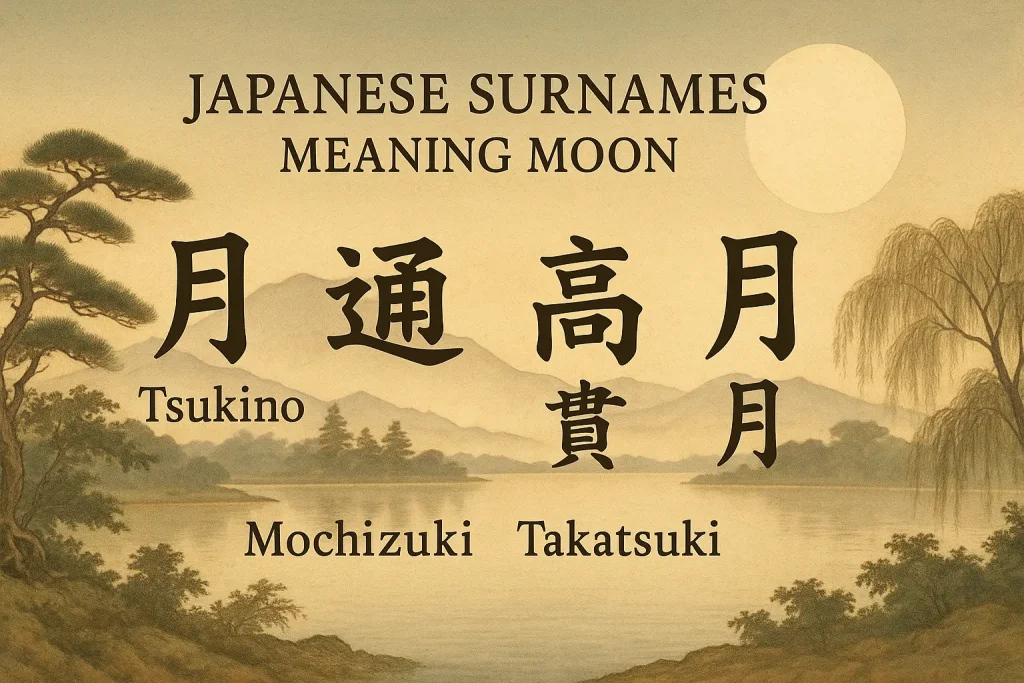
These names don’t just describe the moon itself; many of them capture the feeling of moonlight falling over forests, reflecting on lakes, or glowing across quiet islands.
- People drawn to soft, gentle, or romantic imagery often find moon-inspired surnames especially charming. They feel peaceful yet meaningful, making them perfect for characters with quiet strength, poetic personalities, or celestial symbolism.
- Writers, name researchers, and even parents exploring Japanese naming traditions, especially those who also browse american girl names like Olivia, Ava, or Charlotte are drawn to these surnames because they instantly add depth and emotional resonance.
- Whether used in storytelling, world-building, or cultural exploration, moon-themed surnames have a timeless quality that continues to inspire.
| Name | Meaning |
|---|---|
| Tsukishima | Moon island |
| Tsukimori | Moon forest |
| Tsukikage | Moon shadow |
| Tsukishiro | White moon |
| Hazuki | Leaf moon |
| Tsukinaga | Long moon |
| Mikazuki | Crescent moon |
| Otsuki | Big moon |
| Tsukino | Of the moon |
| Fumizuki | Month of the moon |
These names pair beautifully with gentle first names and add a peaceful, romantic touch to any full name.
Whether you’re creating a character, exploring poetic Japanese identity, or simply drawn to celestial symbolism, moon-inspired surnames offer a soft and meaningful way to capture the beauty of the night sky.
Japanese Surnames With Dark Meanings
While many surnames are inspired by nature, seasons, or gentle imagery, there is another category that holds a powerful appeal surnames with dark meanings.
These surnames are not negative; instead, they capture the dramatic, mysterious, and shadowed side of Japan’s cultural imagination. Rooted in folklore, ancient landscapes, supernatural legends, or powerful natural forces, these names carry an intensity that instantly creates mood and depth.
Japan has a long history of storytelling involving spirits, mythical creatures, moonlit forests, storms, and haunted landscapes. Because of this, surnames with darker symbolism developed naturally through centuries of mythology and regional tales.
| Name | Meaning |
|---|---|
| Kurayami | Darkness |
| Onizuka | Demon mound |
| Kurogane | Black steel |
| Yorukawa | Night river |
| Akamori | Red forest |
| Kuroishi | Black stone |
| Murakumo | Gathering clouds |
| Yamino | Of the darkness |
| Akakage | Red shadow |
| Kageyama | Shadow mountain |
These surnames with dark meanings are often used in anime, fiction, fantasy writing, and even video games because they instantly create atmosphere, tension, and emotional weight.
They’re perfect for dramatic storylines and characters who carry mystery, strength, or an untold history within their name.
Royal Surnames
Japan’s imperial family traditionally does not use surnames, but throughout history, several aristocratic clans rose to prominence and became symbols of nobility, power, and cultural refinement.
These families helped shape Japan’s political structure, arts, literature, and warrior traditions. Because of their importance, their clan names are often treated as royal surnames, even though they function more like historical titles.
Their legacy carries an air of dignity and sophistication, making these names highly appealing for anyone seeking a sense of heritage and grandeur.
- These surnames are tied to Japan’s classical courts, ancient battles, and the rise and fall of influential clans. Some ruled vast regions, others advised emperors, and many played defining roles in shaping Japanese society.
- Writers and historians often use these surnames when creating noble characters, fantasy royalty, or historical fiction because they instantly evoke prestige and cultural depth.
- Whether you’re crafting a heroic leader, a noble family line, or a character inspired by traditional Japan, these aristocratic surnames add richness, elegance, and timeless presence.
These surnames are ideal for historical characters, fantasy writing, world-building, or anyone seeking a name that carries a sense of prestige, legacy, and cultural depth.
They instantly elevate a character or family background, making them perfect for stories rooted in tradition, honor, or aristocratic influence.
Japanese Male Names And Surnames
When pairing surnames with male names, softer-sounding or virtue-based given names often create a balanced rhythm.
Traditional male names connect beautifully with natural, strong, or historical surnames. Below are 50 culturally authentic combinations you can use for characters, writing, or naming inspiration.
| Ren Yamamoto | Haruto Takahashi |
| Isamu Minamoto | Riku Kurogane |
| Daichi Fujita | Hiroshi Watanabe |
| Kaito Moriyama | Sora Nakamura |
| Yuto Aoyama | Makoto Tanaka |
| Tatsuya Kobayashi | Shun Suzuki |
| Akio Hashimoto | Hayato Inoue |
| Kazuki Saito | Naoki Yamaguchi |
| Taiga Hoshikawa | Shinji Tsukishima |
| Ryota Matsuda | Kenji Kato |
| Itsuki Mori | Yuji Kawabata |
| Kento Noguchi | Masato Hasegawa |
| Takumi Endo | Kota Fujimoto |
| Shoji Kamizaki | Ryohei Mizuno |
| Yuma Komatsu | Haru Ito |
| Junpei Kawaguchi | Minato Shimizu |
| Keita Morita | Toma Harada |
| Ritsuki Asano | Aoi Kanda |
| Yori Akamori | Shiro Kagurazaka |
| Osamu Kurosawa | Reo Sawamura |
| Ayumu Takagi | Kazuya Nishida |
| Jiro Ouchi | Yuuma Sakurai |
| Hiroto Kurobane | Teppei Kanzaki |
| Shoma Arakawa | Subaru Onizuka |
These combinations feel culturally authentic, phonetically balanced, and naturally Japanese.
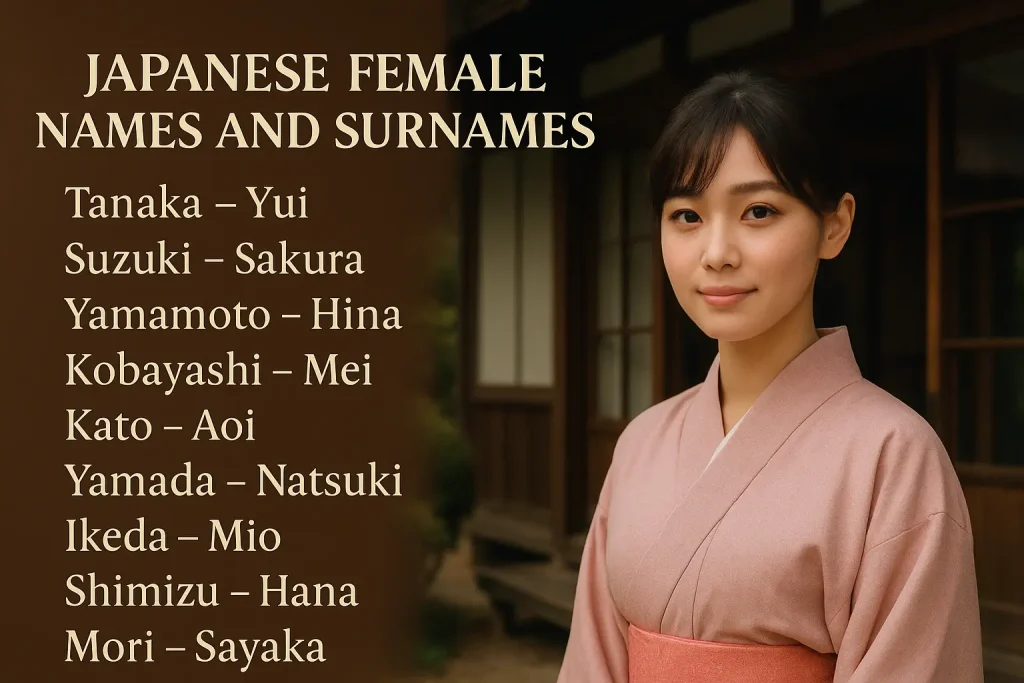
Japanese Female Names And Surnames
Female name combinations often blend elegance, softness, nature imagery, and poetic symbolism.
Many surnames pair beautifully with floral, seasonal, or virtue-inspired feminine names. Below are 50 graceful and harmonious combinations perfect for characters, stories, or baby name ideas.
| Aimi Tsukishiro | Hana Kobayashi | Mio Hoshikawa |
| Yui Tanaka | Amaya Fujimoto | Saki Aoyama |
| Emi Yamamoto | Haruka Watanabe | Aoi Takahashi |
| Ayaka Moriyama | Noa Inoue | Rina Sato |
| Chihiro Kondo | Hina Nakamura | Kaede Matsuda |
| Mei Suzuki | Nanami Kawashima | Yuna Kamizaki |
| Arisa Mori | Sumire Hasegawa | Koharu Shimizu |
| Reina Harada | Ayame Noguchi | Misaki Yamaguchi |
| Kairi Arai | Mika Fujita | Riyo Kawabata |
| Sae Minamoto | Ema Ouchi | Yurina Kurogane |
| Wakana Sakurai | Yuzuki Tsukimori | Hotaru Kanzaki |
| Ayano Mizuhara | Hoshino Tsukishima | Rin Morita |
| Maika Akamori | Sora Kagurazaka | Yume Komatsu |
| Kanna Nishida | Akari Kato | Suzume Arakawa |
| Yuri Hoshikawa | Natsuki Takagi | Kokoro Endo |
| Tomoyo Kurosawa | Ayumi Ogawa | Miharu Shishikura |
These pairings reflect elegance, harmony, and timeless Japanese beauty.
Unique Japanese Surnames For Creative Use
If you’re drawn to names that feel different, mystical, artistic, or deeply atmospheric, unique surnames offer a treasure trove of inspiration.
These surnames often come from poetic place names, ancient cultural practices, spiritual references, or natural elements that aren’t typically seen in everyday Japanese naming.
Unlike common family names tied to rice fields or forests, these rare and imaginative surnames feel special, almost like fragments of stories waiting to be told.
| Name | Meaning |
|---|---|
| Sakurazaka | cherry blossom hill |
| Aoyama | blue mountain |
| Mizuno | of water |
| Kagurazaka | sacred dance hill |
| Akizuki | autumn moon |
| Tsukikawa | moon river |
| Hinode | sunrise |
| Kazehaya | wind valley |
| Yukishiro | white snow |
| Tokiyama | time mountain |
| Otomori | sound forest |
| Shirayuki | white snow |
| Amanogawa | heavenly river |
| Hoshizaki | star cape |
| Umetsu | plum harbor |
| Kazahana | wind flower (snowflake) |
| Nighara | rain plain |
| Suiren | water lotus |
| Kisaragi | second month / late winter |
| Komorebi | sunlight through trees |
| Nunokawa | cloth river |
| Tatsumi | dragon path |
| Hoshiumi | star ocean |
| Toukai | eastern sea |
| Shiranami | white wave |
| Kurotsuki | black moon |
| Miyahara | temple field |
| Sazanami | rippling waves |
| Kurotsuba | black wing |
| Harukaze | spring wind |
| Tsukihara | moon meadow |
| Hinatayama | sunny mountain |
| Yukimine | snow peak |
| Hotarubi | firefly light |
| Kuroyuri | black lily |
| Ameharu | spring rain |
| Tsujioka | crossroad hill |
| Natsumiya | summer shrine |
| Shirogane | silver |
| Uchizora | inner sky |
| Togetsu | crossing moon |
| Hibikino | echoing field |
| Kohinata | small sunny place |
| Aozora | blue sky |
| Yakumo | eight clouds |
| Hanamori | flower forest |
| Yorihara | reliable field |
| Inabikari | lightning flash |
| Tsukiyomi | moon reading / ancient moon deity |
| Natsukawa | summer river |
These unique surnames are ideal for writers, artists, character designers, or anyone who wants a name that stands out with charm, symbolism, and creativity.
Conclusion
Exploring Japanese surnames opens a doorway into centuries of culture, meaning, and identity. From names shaped by mountains, rivers, and forests to rare surnames inspired by moonlight, shadows, or noble clans, each one carries a story rooted in Japan’s traditions and landscapes.
Whether you’re choosing a surname for writing, character creation, cultural research, or personal curiosity, the beauty of Japanese naming lies in its ability to blend history with poetry.
As you move through common, rare, dark, moon-inspired, and unique surnames, you’ll notice how each name captures a feeling of strength, elegance, mystery, or serenity.
That’s what makes Japanese surnames so special: they don’t just label a person; they reflect a lineage, a place, and a moment in time.
With so many rich options to explore, you’re sure to find the name that feels meaningful, expressive, and perfectly suited to your creative or personal needs.