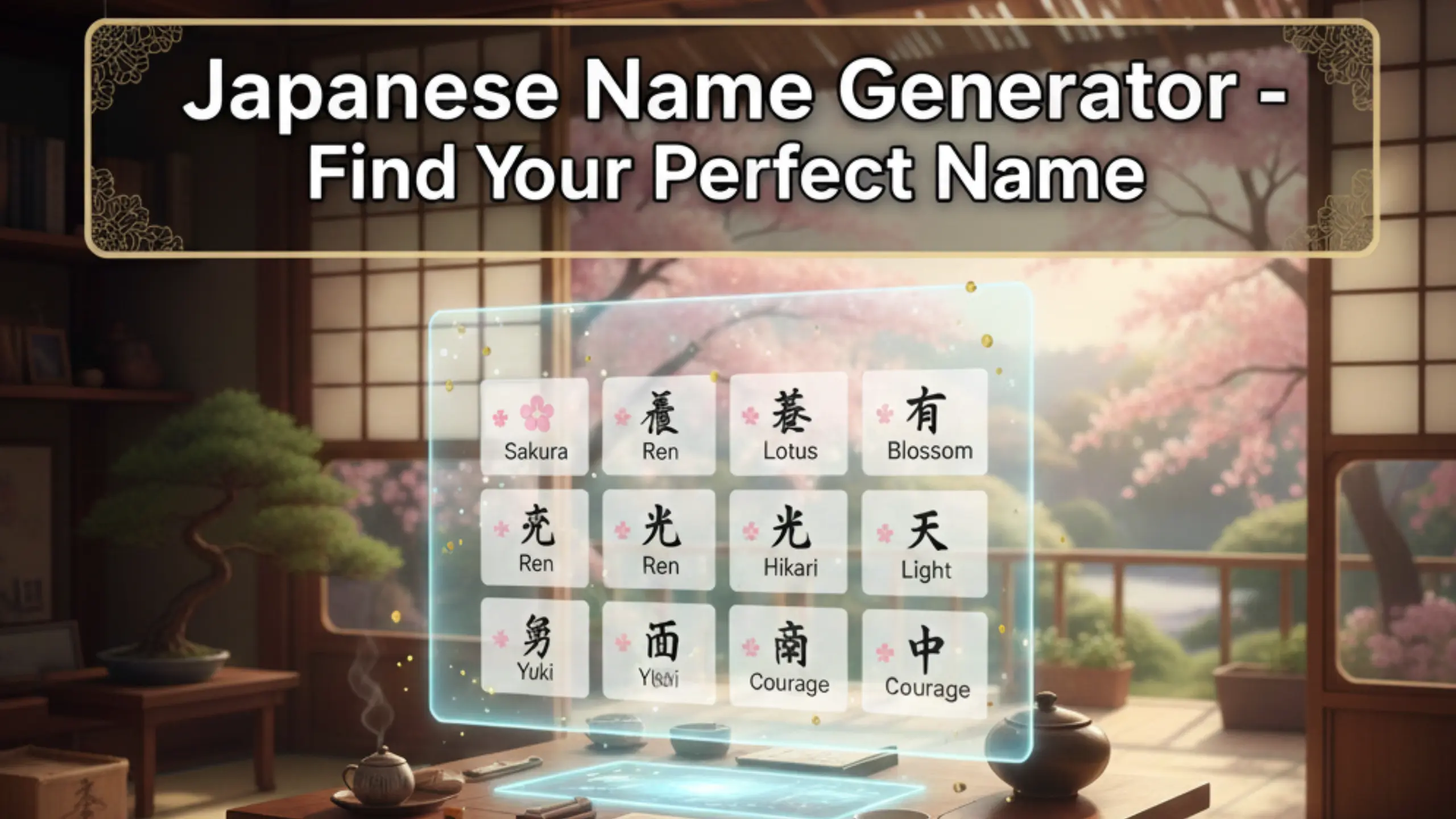
Japanese Name Generator – Find Your Perfect Name
Working with Japanese names has always fascinated me, especially when I first tried turning English ideas into names filled with meaning, aesthetics, and quiet nuance.
When people explore a Japanese name generator, they often start with a simple translation, but I’ve found that the real magic comes from understanding how kanji, characters, and naming traditions shape each choice.
Japanese Name Generator
Enter any word to generate authentic Japanese names
Generated Names (Click to Copy)
Even the Japanese idiom “Ten men, ten colors” reminds me that every person brings a different style, whether they are looking for something computer-generated or inspired by Western names.
A name may begin with a small starting point, like a feeling or memory, and then shift through layers of specific meaning until it becomes something personal.
I’ve seen how a name like Ren can transform from lotus to love or even cold, and how these subtle changes turn simple labels into tiny poems, almost like art in miniature form.
When turning English concepts into Japanese names, I often look at how old and new elements blend echoes of samurai-era values such as honor, nature, and rank, balanced with modern names that use softer sounds and aspirational meanings.
Names like Hikaru (a sense of light) or Souta (a mix of peaceful and big feelings) show how a name can tell a story before a single dialogue is spoken. Over time, I’ve learned that cultural changes, personal origins, and even someone’s region, surnames, or first name preference all influence the final choice.
Whether someone is using a Japanese names list, a Japanese name generator, or adapting ideas from English, every step becomes part of a living tradition and history, shaped by what each person hopes their name will express, and how pop culture might inspire them along the way.
The Origins & Cultural Depth Behind Japanese Names
Japanese names carry a unique blend of meaning, tradition, and quiet aesthetics that set them apart from naming systems in many other cultures. While Western names often rely more on sound or family continuity, Japanese names are built using kanji, characters that each hold a specific and layered meaning.
A single name can unfold into different interpretations depending on the kanji chosen, something I learned firsthand when I discovered that “Ren,” a popular name today, can mean lotus, love, or even cold.
Creating Authentic Japanese Character Names
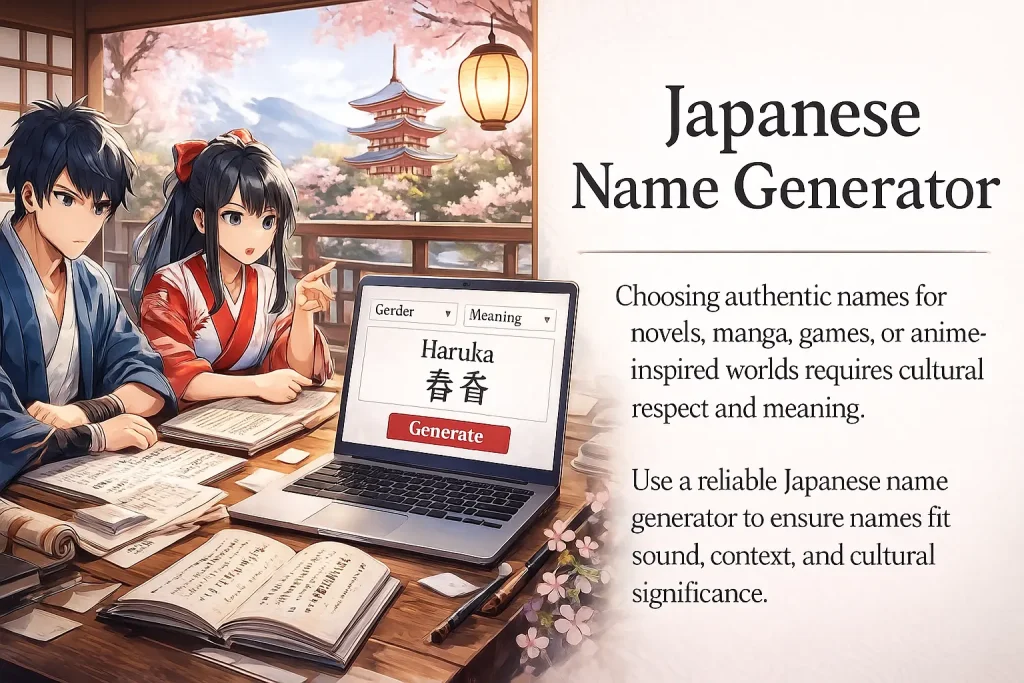
If you’re writing a novel, crafting a manga, designing a game, or building an anime-inspired world, choosing the right Japanese character name requires thoughtful decisions. It’s not only about what sounds nice; it’s about carrying cultural respect and meaning.
This is where a reliable Japanese name generator helps, especially one that offers options grounded in culture, meaning, and context.
Being someone who often writes characters myself, I’ve learned the difference between just picking a name and creating a name that truly belongs in its setting.
- When adapting ideas from other languages, like using a Japanese name generator from English, it becomes even more important to consider both sound and meaning.
- English concepts often carry emotion or imagery, and pairing them with the right kanji can transform them into beautiful Japanese names that preserve the essence of the original thought.
- Below are key points that help you craft authentically Japanese names, even if you’re new to the language:
Most Japanese names have layers of meaning based on the kanji used. When building characters, choose meanings that align with their personality, backstory, or emotional arc. For example, a gentle, quiet protagonist might suit a name like Haruka (distant, spring), while a bold warrior could carry something like Raiden (thunder).
While many names are unisex—Ren, Makoto, Nao—others lean strongly male or female. A Japanese girl name generator helps when you need feminine names such as Sakura, Yui, or Chihiro. A Japanese male name generator supports finding names like Haruto, Takashi, or Kenshin.
Match Name Style To Setting
When choosing Japanese names for your characters, the setting plays a huge role in determining what feels authentic. A historical piece or a jidaigeki drama filled with samurai, warriors, or traditional villages calls for names that carry a strong, classical tone.
Names like Tomoe, Toshiro, or Shingen instantly anchor a character in an older era because they reflect cultural values and naming patterns of the time.
Consider The Surname-First Format
One of the most important cultural details to get right is the name order. In Japanese tradition, the surname comes first, followed by the given name. So, instead of Yuna Takahashi, the correct format in Japan is Takahashi Yuna. This applies in schools, workplaces, formal settings, and everyday introductions.
Writers who want cultural accuracy whether in novels, manga, anime-style stories, or games benefit from remembering this structure. If you’re not sure how to pair names correctly, a Japanese first and last name generator can help create combinations that sound natural and respectful of naming customs.
Using the proper order adds authenticity and subtly shows readers that the story honors the cultural framework.
Popular Japanese Character Names
Here are well-loved Japanese character names from anime, film, games, and literature:
| Light Yagami | Death Note |
| Chihiro Ogino | Spirited Away |
| Kenshin Himura | Rurouni Kenshin |
| Yuna | Final Fantasy X |
| Satoru Fujinuma | Erased |
| Misaki Ayuzawa | Maid Sama! |
| Shinji Ikari | Neon Genesis Evangelion |
| Nanami Momozono | Kamisama Kiss |
| Goro Akechi | Persona 5 |
| Sakura Kinomoto | Cardcaptor Sakura |
These names show how much emotional and narrative weight a good Japanese name can carry.
How Japanese Name Generator Works?
A strong random Japanese name generator usually offers 10 names at a time, mixing first and last names in the correct Japanese order.
It is useful for writers who need names quickly, perfect when brainstorming a game roster, filling out a classroom scene, or populating a town in a fantasy world.
- Since many names shift meaning depending on kanji, a Japanese name generator with meanings helps users understand the symbolism behind each option.
- This is especially helpful when matching names to complex characters, as in novels or role-playing games.
- It also offer specialized categories:
Each tool can support worldbuilding in a different way.
Japanese Last Names For Writers & Creators
Japanese surnames carry deep cultural nuance, and for writers, creators, and worldbuilders, choosing the right japanese family names can instantly shape a character’s presence, lineage, or emotional tone.
Many of these surnames originate from nature, geography, or traditional occupations, giving them a grounded feel that works beautifully in stories across genres, whether you’re crafting a historical drama, a slice-of-life manga, a fantasy series, or a modern Tokyo-set novel.
| Takahashi | bridge |
| Sato | wisteria |
| Kobayashi | forest |
| Yamamoto | mountain |
| Nakamura | village |
| Fujimoto | wisteria |
| Watanabe | crossing |
| Ito | thread |
| Tanaka | ricefield |
| Suzuki | bellwood |
| Sasaki | assistant |
| Yamaguchi | mouth of the mountain |
| Matsumoto | pine |
| Inoue | well |
| Kimura | tree |
| Shimizu | clear water |
| Hayashi | woods |
| Abe | peaceful |
| Kondo | near hall |
| Okada | ridge |
| Ishikawa | stone river |
| Nakajima | island |
| Harada | field |
| Ueda | upper field |
| Hirano | plains |
| Endo | distant |
| Aoki | blue |
| Murakami | upper village |
| Kato | increase |
| Ono | axe field |
| Mori | forest |
| Hashimoto | bridge base |
| Yoshida | luck |
| Uchida | on the inside |
| Sugiyama | cedar |
| Sakamoto | slope |
| Hasegawa | valley river |
| Kaneko | metal |
| Ota | big field |
| Imai | now well |
| Tamura | rice village |
| Fukuda | fortunate |
| Goto | later door |
| Ando | peaceful |
| Ishii | stone rock |
| Kuroda | black field |
| Fujii | wisteria well |
| Matsuda | pine field |
| Sakai | border |
| Kojima | small island |
| Noguchi | field mouth |
| Oshima | big island |
| Takagi | tall tree |
| Chiba | thousand leaves |
| Nagata | long field |
| Kawaguchi | river mouth |
| Iwasaki | rock cape |
| Miyazaki | shrine cape |
| Tsuchiya | sand house |
| Hattori | clothes |
| Arakawa | rough river |
| Kishimoto | shore base |
| Takenaka | bamboo inside |
| Mizuno | water field |
| Kubota | sunken field |
| Kawamoto | river base |
| Okamoto | ridge base |
| Matsui | pine well |
| Ishida | stone land |
| Shibata | brush field |
| Higuchi | entrance |
| Numata | swamp field |
| Uehara | upper plain |
| Hamano | beach field |
| Asano | shallow field |
| Kurihara | chestnut plain |
| Oka | hill |
| Kawai | fertile |
| Shindo | new way |
| Takayama | tall mountain |
| Miyamoto | shrine origin |
| Sugimoto | cedar basis |
| Kubo | sunken place |
| Hoshino | star field |
| Saeki | peninsula |
| Tsuchida | soil field |
| Amano | heavenly |
| Kurokawa | black river |
| Akagi | red castle |
| Okazaki | ridge cape |
| Kamata | upper rice field |
| Hamada | shore field |
| Nakano | middle ground |
| Tsukamoto | mound base |
| Sugawara | reed field |
| Kikuchi | chrysanthemum pond |
| Masuda | increasing field |
| Tojo | east castle |
| Koguchi | small mouth |
| Minami | south |
Japanese Girl Names List
Japanese girl names often carry meanings drawn from nature, emotion, seasons, beauty, and spiritual qualities. They feel gentle and elegant, yet they can hold incredible emotional strength depending on the kanji used.
Whether you’re building a tender heroine, a bold adventurer, or a dreamy slice-of-life protagonist, Japanese girl names offer layers of symbolism that enrich a character’s inner world.
| Name | Meaning |
|---|---|
| Aiko | love |
| Sakura | blossom |
| Yui | bind |
| Chihiro | thousand |
| Miyu | gentleness |
| Haruka | spring |
| Yuna | kindness |
| Hikari | light |
| Naomi | honesty |
| Sora | sky |
| Rin | dignity |
| Emi | smile |
| Megumi | blessing |
| Kanna | guidance |
| Ayumi | walk |
| Hana | flower |
| Nozomi | hope |
| Kokoro | heart |
| Miku | future |
| Akari | brightness |
| Kaori | fragrance |
| Nana | seven |
| Rei | lovely |
| Sayuri | lily |
| Ami | friend |
| Hinata | sunlight |
| Yume | dream |
| Kiyomi | purity |
| Airi | affection |
| Tomoe | wisdom |
| Riko | jasmine |
| Ayaka | color |
| Mei | sprout |
| Kaho | warmth |
| Yuriko | lily |
| Asuka | fragrance |
| Mao | dance |
| Shiori | poem |
| Momoka | peach |
| Ichika | one |
| Suzume | sparrow |
| Misaki | bloom |
| Kagura | song |
| Atsuko | sincere |
| Mizuki | moon |
| Eri | blessing |
| Sumire | violet |
| Mai | dance |
| Kumiko | companion |
| Fuyuko | winter |
Japanese Male Names List
Japanese male names often carry meanings tied to strength, virtue, intelligence, nature, and resilience. They tend to project a sense of calm confidence, discipline, or quiet determination qualities that make them ideal for protagonists, rivals, mentors, or even mysterious supporting characters.
Names such as Haruto, Takashi, Ren, Souta, Kenshin, and Satoru feel timeless because they blend poetic nuance with masculine energy.
- Whether you’re writing a manga hero, a game warrior, a modern slice-of-life lead, or a reserved scholar with hidden depth, Japanese male names offer layers of symbolism.
- Drawing inspiration from a Japanese male name generator, here is an extended list of names that suit characters across eras, genres, and emotional arcs.
| Name | Meaning |
|---|---|
| Haruto | sun |
| Takashi | noble |
| Ren | lotus |
| Souta | big |
| Kenshin | trust |
| Satoru | wisdom |
| Yuto | gentle |
| Itsuki | timber |
| Daiki | great |
| Ryota | cool |
| Shun | swift |
| Yuji | courage |
| Kazuki | harmony |
| Hiroto | vast |
| Riku | land |
| Naoki | honest |
| Kaito | ocean |
| Minato | harbor |
| Keita | blessed |
| Isamu | bravery |
| Makoto | truth |
| Ryusei | comet |
| Akira | clarity |
| Hayato | falcon |
| Takeru | warrior |
| Yoshito | good |
| Shogo | correct |
| Haruki | shining |
| Natsu | summer |
| Kouhei | peace |
| Taiga | big river |
| Shinji | true |
| Masato | justice |
| Rei | zero |
| Subaru | unite |
| Kazuya | harmony |
| Eito | eternity |
| Yuuta | abundant |
| Tatsuya | dragon |
| Jiro | second |
| Haru | spring |
| Kei | respect |
| Arata | fresh |
| Koshiro | dawn |
| Yamato | great harmony |
| Ryoma | dragon horse |
| Kazuma | peace |
| Masaki | brightness |
| Shunpei | excellence |
| Hinata | sunlight |
Japanese-Inspired Fantasy Names For Stories
Japanese fantasy names possess a unique ability to evoke both an ancient and otherworldly feel, making them ideal for mythological universes, alternate-history realms, celestial kingdoms, or supernatural storylines.
These names often draw inspiration from nature, folklore, spiritual concepts, and poetic imagery, yet they remain grounded in familiar Japanese phonetic patterns. That balance is what gives them their striking charm: the sense that they belong to both this world and another hidden just beyond the veil.
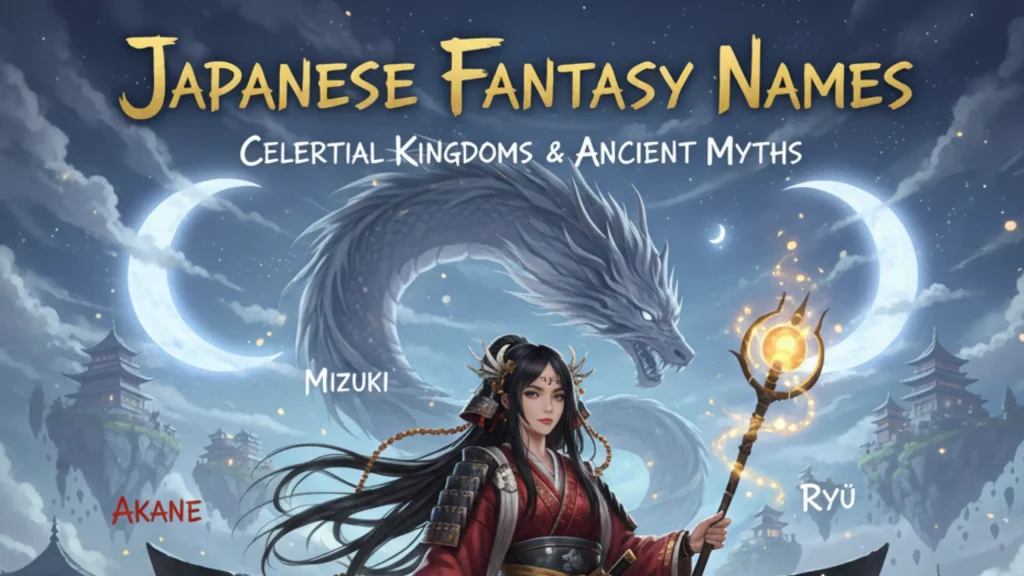
In fantasy writing, a well-crafted name can instantly define a character’s aura. A warrior with a storm-born destiny, a shrine maiden infused with celestial magic, or a spirit who walks between shadows and dawn, each becomes more vivid when their name carries symbolic weight.
Names like Raiyuko (“thunder child”) or Kurohane (“black feather”) bring atmosphere before the character ever speaks.
- Shirotsume feels like a gentle spirit of blossoms, while Yamitsuki evokes a figure touched by darkness or night magic. And Aozora-no-Kami, with its divine sky imagery, sounds like a deity shaping winds, storms, or fate itself.
- A Japanese fantasy name generator often blends real language roots with imaginative compounds, making it a powerful tool for creators who want dramatic flair without straying too far from authentic structure.
- This helps you craft characters who stand firmly within a Japan-inspired world yet feel fresh, mythical, and alive.
- Below is an extended list of fantasy-ready names to spark your imagination. These can be used for heroes, spirits, gods, demons, guardians, or legendary creatures within your own universe. Each name is crafted to carry emotional weight, cultural nuance, and a sense of magic.
| Name | Meaning |
|---|---|
| Raiyuko | thunder child |
| Kurohane | black feather |
| Shirotsume | white blossom |
| Yamitsuki | moon of darkness |
| Aozora-no-Kami | god of the blue sky |
| Tsukihana | moon blossom |
| Kageyori | shadow-born |
| Amaryu | rain dragon |
| Hoshikage | star shadow |
| Kazanori | fire spirit |
| Suirenmaru | lotus soul |
| Amefune | storm ship |
| Kurozora | dark sky |
| Tenshiaki | angelic radiance |
| Yorukumo | night cloud |
| Mizukiba | water fang |
| Hoshimori | star guardian |
| Kazekuro | black wind |
| Akayume | crimson dream |
| Inarimaru | fox circle |
| Shinjugami | pearl god |
| Sakurayori | blossom-born |
| Kamenotsume | turtle claw |
| Hikarizora | sky of light |
| Oniwake | demon splitter |
Fantasy worlds thrive on details, and names like these help shape atmosphere, hierarchy, and mythology.
Whether you’re designing gods, yokai, celestial beings, or heroic adventurers, Japanese-inspired fantasy names offer the perfect mix of poetic elegance and dramatic impact.
Japanese Names From English Concepts
Naming characters based on English concepts can open the door to poetic, symbolic, and emotionally rich Japanese names. When writers want a name that captures a theme like hope, grace, or winter using a Japanese name generator from English can bridge the gap between languages without losing the heart of the idea.
This method is especially helpful for creators who want their characters to carry emotional weight or symbolic depth that aligns with their story arc.
For example, the English word “Hope” transforms into Nozomi, a name filled with optimism and quiet strength. “River” becomes Kawa or Kaworu, invoking calm flow or natural energy.
| Word | Japanese Name / Meaning |
|---|---|
| Hope | Nozomi |
| River | Kawa / Kaworu |
| Sky | Sora |
| Winter | Fuyuko |
| Grace | Megumi |
This approach works beautifully when a writer wants the Japanese name to reflect an English-language idea without losing nuance.
Japanese Restaurant Name Ideas
When crafting a fictional setting, designing a cultural world, or naming an actual business, Japanese restaurant names add personality, atmosphere, and cultural flavor.
For writers and worldbuilders, these names instantly establish the tone of the environment whether cozy, elegant, modern, traditional, or whimsical. And for business owners, the right name can define a brand’s identity and charm customers before they even see the menu.
Names like Sakura Tei (“cherry blossom pavilion”) evoke warmth and softness, giving the sense of a serene, beautifully decorated restaurant serving traditional dishes.
| Name | Meaning |
|---|---|
| Sakura Tei | cherry blossom pavilion |
| Miso Hana | miso flower |
| Kitsune Kitchen | fox kitchen |
| Aoi Ramen Bar | blue ramen bar |
| Fujiyama Grill | Mount Fuji grill |
A Japanese restaurant name generator offers many options that blend cultural charm with brand-friendly appeal.
Conclusion
Japanese names carry layers of beauty, symbolism, and cultural depth, making them some of the most expressive choices for characters, worldbuilding, or even real-life naming.
Whether you’re inspired by nature, history, fantasy, or English concepts transformed into Japanese meaning, there’s a name that fits every story and emotion. Tools like Japanese name generators can spark ideas, but understanding the meaning behind each name allows you to choose with intention and authenticity.
From gentle girl names to powerful male names, from evocative fantasy names to meaningful surnames, the world of Japanese naming is rich, poetic, and full of creative potential offering endless possibilities for writers, creators, and dreamers alike.